
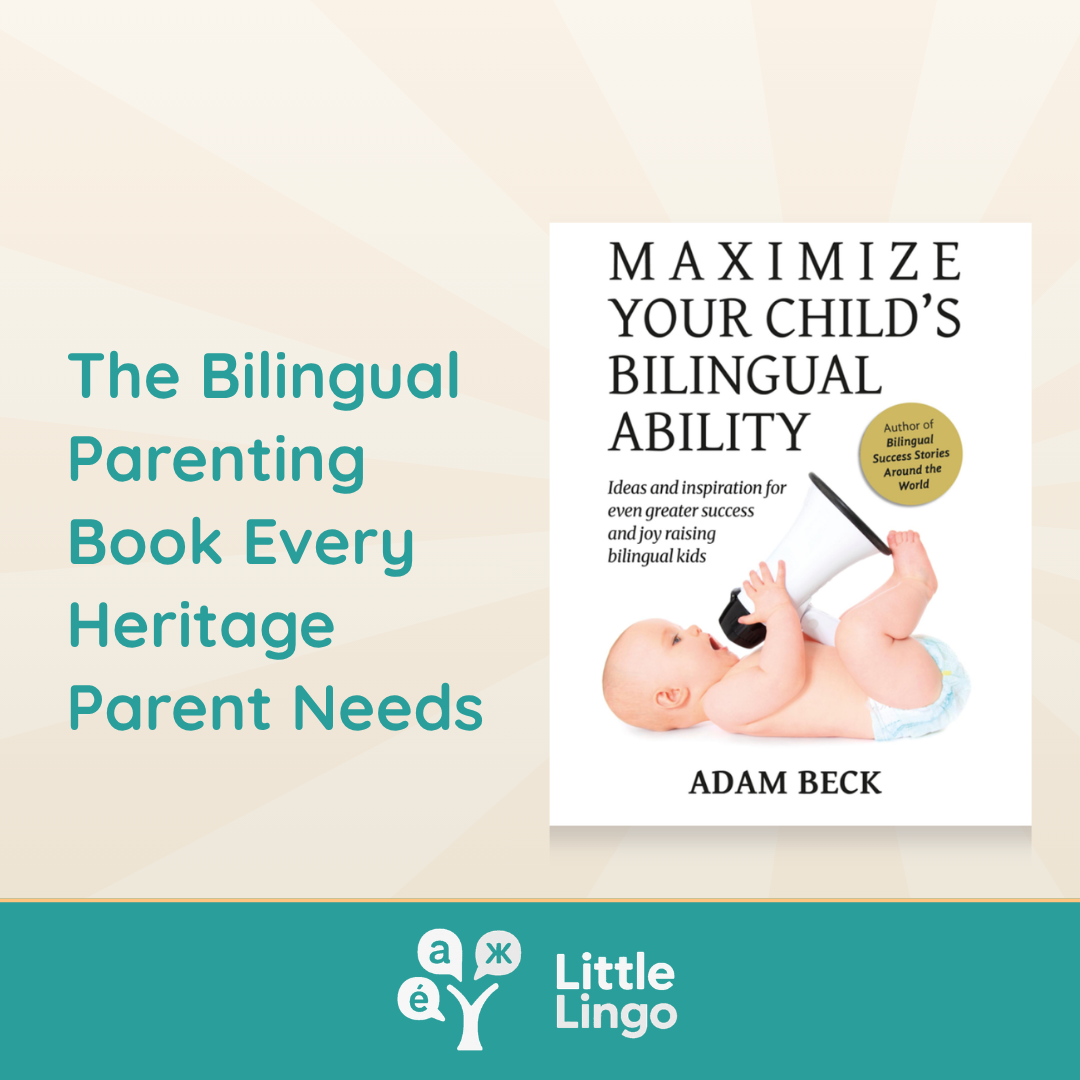
“The ideal formula for nurturing good bilingual ability in a child involves being both extremely serious about the aim, and yet extremely playful about the approach.”
Adam Beck, Maximize Your Child’s Bilingual Ability
No two bilingual families are made equal. Some have both parents speaking the minority language, some have just one, some are juggling three languages across two continents of relatives. Most bilingual parenting advice assumes a single, tidy setup and asks you to fit yourself into it. Adam Beck’s book “Maximize Your Child’s Bilingual Ability” on the contrary, hands you thirty ways of thinking and thirty practical habits, then trusts you to pick what actually suits your household, your child, and your week. That flexibility is what makes this one worth reading, whatever your family looks like.
Here’s what this book review will cover:
- Why Adam Beck’s Maximize Your Child’s Bilingual Ability has become required reading for bilingual parents;
- The three ideas from the book that shift how you think about your own family’s journey;
- Who this book suits, and who might want something else instead;
If you’re raising a child in more than one language and wondering how you can do it right, this one’s for you.


Buy your copy of Maximize Your Child’s Bilingual Ability. You can also read interview with Adam Beck.
I earn a commission if you purchase through these links, at no extra cost to you.
Who Is Adam Beck, and what makes him an authority on bilingual parenting?

Adam Beck is a teacher, coach, writer, and parent, thirty years deep in bilingual development. He runs the popular blog Bilingual Monkeys, followed by bilingual parents worldwide, and raised his own two children bilingually with his wife Keiko in Hiroshima, Japan. 10 years and over 10,000 copies since it first published, Maximize Your Child’s Bilingual Ability hasn’t dated.
It’s no accident this book keeps turning up on every “best books for raising bilingual children” list going. Beck’s book is built around concrete, doable ideas. Its structure, thirty short Perspectives followed by thirty short Principles, means you can read a chapter in three minutes, whether that’s between nappy changes or during that precious time when your toddler has become deeply, suspiciously absorbed in a spatula.
TL;DR
Maximize Your Child’s Bilingual Ability is built around thirty “Principles” and thirty “Perspectives” on raising bilingual children, grounded in his own family’s experience and years of supporting parents. The central messages: consistency and mindset matter more than any single method, setbacks are part of the process rather than proof of failure, and the parent speaking the minority language deserves as much support as the child does. It is warm, specific, and unusually honest about how long this journey takes.
Does the book speak to both minority and majority language parents?
Beck is upfront in his introduction that this book is not meant to hand you a single correct method. He describes his approach as grounded in research on bilingualism and language acquisition, but built primarily from the daily, lived reality of raising his own children across two languages and cultures.
He writes separate messages to majority language parents and minority language parents, acknowledging that the emotional experience differs depending on which role you’re in within your family. That distinction is important. So much advice online assumes every bilingual household looks the same.
“The process of raising a bilingual child is a marathon , not a sprint. And … supporting the long-term language development is a process that can only be addressed in a small, persistent steps, day after day.”
3 key ideas
- Your role as a parent is treated as part of the plan. Most guidance on raising bilingual children focuses on the child’s development. Beck spends time on the parent, particularly the one carrying the minority language largely alone within the household. He names the isolation that can come with that role directly, rather than glossing over it with reassurance. For any parent who has ever felt like the sole guardian of a heritage language while their partner gets to be the relaxed one, this section alone offers a kind of relief that’s hard to find elsewhere.
- Persistence, not perfection, is what carries the journey. One of the book’s recurring themes is that resistance, regression, and the child’s refusial to speak the minority language are not signs of failure. “The only way to really fail at raising a bilingual child is to give up entirely”. Beck frames the whole endeavour as a long journey measured in years, where persistence matters more than any single bad week. If you’ve ever spiralled after your child answered grandma in English for the third time running, this reframe changes the entire emotional weather of your week.
- Small, daily moments do the heavy lifting. The Principles section moves from mindset into practice, with chapters on reading aloud daily, building a print-rich home, storytelling, and turning ordinary moments, including the difficult ones, into language opportunities. None of it requires flashcards or a curriculum. Most of it requires finding fifteen minutes and using them differently.
Practical toolkit inside
What sets this book apart from a lot of parenting advice is how specific the techniques are. For example, Beck draws on expertise from specialists in the field, including strategies from Ana Paula Mumy, a popular trilingual speech-language pathologist. Some of her techniques for encouraging the minority language include:
- Narration. Talk through what you and your child are doing, seeing, hearing, smelling, tasting. “We’re washing the carrots, look how orange they are”.
- Choices. When a open-ended question feels like too much to ask for, offer two options instead. “Do you want a banana or an apple?” lowers the pressure of the response while keeping the minority language in the conversation.
Beck covers two more strategies in this same chapter, along with a wider list for trickier moments.
The biggest advice of the book
The secret to raising a bilingual child successfully is reading aloud, and reading like you mean it. Beck places reading at the very centre of nurturing the minority language, recommending at least 15 minutes a day as a foundation habit. Just as important as the time spent is how you read. Children’s stories are built to be dramatic, and Beck’s advice is to match that energy: vary your voice for each character, let the tension build, don’t be afraid to overact a little. A flat, hurried read-through does far less for language development than one delivered with some proper theatre behind it.
These techniques are a small sample of what’s covered across the book’s Principles chapters, each one this specific and this easy to put into practice the same day you read it.
Common Questions About This Book
Is it only useful for parents just starting out?
No. The early chapters suit parents at the beginning of their journey, but the later sections on schooling, grandparent relationships, and sustaining habits over years speak directly to families further along the path.
Does it help if only one parent speaks the minority language?
This is arguably where the book is strongest. Beck addresses the one-parent, one-language dynamic in depth, including the particular emotional load carried by the sole minority language speaker at home.
Does it support academic theory?
It references research where relevant, but leans far more on lived, practical experience than clinical study. Parents wanting a research-first approach may want to pair it with a more academic title alongside this one.
How long does it take to read?
Its structure, short Perspectives and Principles rather than long chapters, makes it easy to read in small pieces during the parts of the day you actually have spare, rather than needing a rare quiet evening.
Key takeaways
This book won’t hand you a magic formula, and Beck’s the first to admit it. What you get instead is permission, real permission, to stop treating the hard days as proof you’re getting it wrong. The mixed-up sentences, the tantrums, the nights you’re too tired to read aloud, all of it still counts.
So here’s the takeaway. Show up, even messily, and the rest sorts itself out over time. Beck spends nearly three hundred pages proving that, and we think it’s worth every one of them.


