
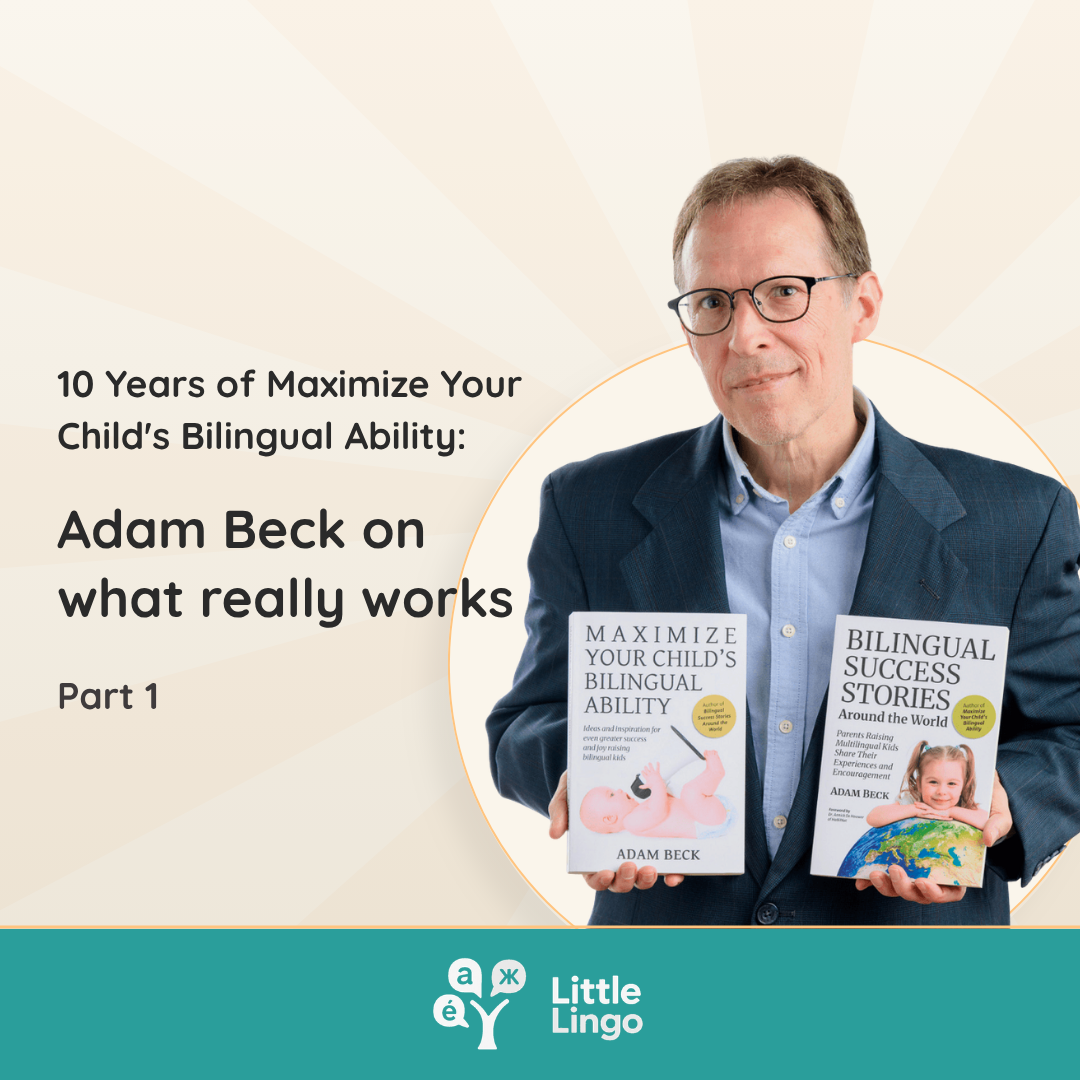
Adam Beck is the author of the widely-read books Maximize Your Child’s Bilingual Ability and Bilingual Success Stories Around the World. He is also the founder of the personal coaching program Bilingual SuperKids and the popular blog Bilingual Monkeys. He recently launched a new AI project called the Bilingual Baby Podcast at Instagram, TikTok, and YouTube. A longtime resident of Hiroshima, Japan, he and his wife have two bilingual children, now 22 and 19, who were raised in Japanese and English.

Buy your copy of Maximize Your Child’s Bilingual Ability. You can also read full review on the book here.
I earn a commission if you purchase through these links, at no extra cost to you.
A Decade of Hindsight
1. Thank you taking time to talk to Little Lingo and congratulations on the anniversary – Maximize Your Child’s Bilingual Ability turned 10 this year! Looking back at what you wrote in 2016, is there anything you’d now say differently?
I wrote Maximize Your Child’s Bilingual Ability when I was in the middle of my own bilingual journey with my kids. At that point, too, I had been teaching English to bilingual children for many years so the book was my attempt to share as much as I could about the success I was experiencing as a parent and teacher in a practical and actionable form for other parents and teachers. I honestly had no grand ambitions for the book, so it’s very gratifying to say that the book has resonated with a lot of people out in the world.

Ten years after the book was published, my own bilingual journey is now over because both my kids are away in college (read my “final interviews” with them, looking back on their bilingual upbringing, at my blog). And during this decade I’ve also personally coached over a hundred parents around the world.
If I was writing the book today, I don’t think I would change the basic content because I believe the ideas in the book, involving mindset and action, remain at the heart of bilingual success. But it’s also true that my perspective on the whole experience of raising bilingual children is now naturally even wider than it was back then. So that wider perspective would surely inform the book in certain ways, though it’s hard to say exactly what the new edition would look like unless I actually revised it!
The Missing Question
2. What’s the one thing about raising bilingual children you wish more people asked you about?
The problem for most parents isn’t, initially, about asking questions. I was fortunate in that I was a longtime teacher of bilingual children before I had kids of my own, which meant that I already had some background knowledge of this subject from the start. But new parents generally have no experience at all when it comes to raising bilingual children. If they’re not proactive about gaining some knowledge early on, they tend to underestimate the size of this challenge and make less productive choices. And a slow start to their bilingual journey can limit—even undermine—the success of their whole bilingual dream.
So my best advice for new parents is to prioritize learning about the reality of this experience from veteran parents and experts in the field. Read books and blogs, watch videos, listen to podcasts, and talk with other parents who are equally serious about their bilingual aim. From that foundation of knowledge, parents will then be in a much stronger position to adopt a productive mindset and pursue fruitful actions, as well as ask effective questions for their particular situation.
“Read books and blogs, watch videos, listen to podcasts, and talk with other parents who are equally serious about their bilingual aim.”
How to Find the Right Books?
3. Throughout the book, you mention the importance of reading aloud to your child. For parents who may have limited access to books in their language, what should they be looking for when choosing books? And what makes a bilingual or heritage language book genuinely good rather than just functional?
I often say that raising a bilingual child is like putting together a huge puzzle with a thousand pieces. Those pieces are all the potential actions you can take to nurture your child’s target language. But the thing is, you don’t need to make use of all those pieces, all those actions, to experience a lot of rewarding success. The “bilingual puzzle” isn’t like a regular puzzle where every piece is basically the same size. In the bilingual puzzle, two of the pieces are much, much bigger than the other pieces. In fact, if you put together your bilingual puzzle with only these two big pieces, and you carried out these two actions as fully and effectively as you could, you would still be able to produce a satisfying picture of bilingual success.
The first big piece of the puzzle—and it’s the biggest piece, the biggest action of all—is talking a lot to your child. Exposure through speech, from you and from other speakers of the target language, can potentially generate the most impact on the child’s language development. However, the truth is, many parents can do better at this. They aren’t really talkative enough. I’m constantly encouraging parents to be more talkative with their children because the more talkative they are, the more talkative their children will eventually be.
And the second biggest piece of the puzzle (I’m finally answering your question!) is reading a lot. Talking a lot in the target language—ample oral input—can take you pretty far on your journey, but to reach higher, more sophisticated levels of language ability, reading aloud is essential, day after day, throughout the years of childhood. Ultimately, books and reading enable you to truly maximize the results of your bilingual journey.
Of course, in order to maintain an effective read-aloud routine, you need resources, you need books. So the hunt for suitable materials, borrowed from the library and bought for your home, must be an ongoing priority.
“Books and reading enable you to truly maximize the results of your bilingual journey.“
For parents with a less-common language, who have more difficulty obtaining appealing books in that language, let me make three suggestions:
Keep looking! The harder you try, the more discoveries you’ll make. Consult with ChatGPT or another AI chatbot to brainstorm ideas. In my experience, every parent I’ve ever worked with, no matter the target language, has found more resources when they tried harder to find them.
You can also use an AI chatbot to produce stories (and illustrations) in your target language. Create customized prompts, asking for stories with characters and themes that you know would interest your child. Even make your child the hero of the story! Children are captivated by stories featuring themselves as the main character, whether listening as you read or reading the stories independently.
Make use of “wordless picture books”. These books have no text so the story is told through the illustrations alone. The beauty of these books—for all parents and especially those parents with a less-common target language—is that you can share these books with your child in any language you like! And you can tailor how you use that language to talk about the book, matching your child’s age, level of ability, and interests. Wordless picture books can be such a powerful resource for providing engaging, effective language exposure. There are many wonderful books in this genre, and you can likely find some at your local library.
Small Time, Real Progress
4. If a parent has only 10 minutes a day for the heritage language, what would you advise them to do with that time?
Broadly speaking, the amount of progress in the target language is generated by the amount of language exposure the child receives—the quantity and quality of that input. More input—with the emphasis on interactive input—typically leads to more progress because that input is the fuel for language development. While I’m happy to support any level of ambition a parent has for their child’s language development, it’s crucial to appreciate the all-important nature of language exposure in order to produce the desired result. And if your aim for your child’s language ability is high, then your drive to provide language exposure must be high, too.
However, if a parent’s commitment of time and energy for their child’s language development is limited, and their ambition is more modest, that’s fine, as long as the parent is realistic about the amount of progress that can be produced from, say, 10 minutes a day. Concretely speaking, this totals little more than 1 hour a week, whereas most parents with a more serious aim for their children’s language development are providing at least 20 hours a week of exposure and engagement.
That said, if the available time for the target language is truly this limited, I would recommend maintaining a daily read-aloud routine, which is a very tangible activity that can be turned into a productive habit. Make reading aloud the bedrock of your ongoing efforts, then try to expand this exposure to the target language in further ways to fuel stronger progress.
The Unexpected Turning Point
5. What’s a moment from your own family’s bilingual journey that didn’t go to plan, but turned out to matter more than you expected?
At the start of my own bilingual journey with my kids I was struggling a lot because I was working long hours as a writer and editor at the city newspaper and couldn’t spend much time with them. My bilingual aim was in serious trouble so I was overjoyed when the newspaper finally let me start working from home. This development was supremely positive because I could then interact with them throughout the day…and yet it also meant that I began experiencing continuous interruptions when I was trying to work. The kids were constantly invading my little home office for one reason or another and this became a growing frustration. One day, though, I finally came to the following conclusion…
Well, Adam, maybe you should try harder to appreciate these interruptions while they last. At least they want to interact with you, and that may not be the case when they’re brooding teenagers. What’s more, it’s through each interaction that you’ll be advancing your larger aims of nurturing their language ability as well as your relationship with them. Even when your work feels “urgent,” that’s hardly ever the case, really—and you always get it done, anyway, right? So what’s the wiser choice here: turning them away to continue your “urgent” business or engaging with them in that moment?
And thus a new pledge was born: Engage with every interruption.
Now I realize we can’t always follow this rule—sometimes we really are busy. But from that moment on, I became much more mindful and proactive about shifting my focus to their little faces when they “invited” me to interact with them. Actually, that’s a good way to look at it: these are invitations, not interruptions. And the more you accept these invitations, and engage with your kids (put down your phone!), the more you’ll nurture both their language development and your loving bond as parent and child.
This is the end of part 1. Read Part 2 of our discussion with Adam here.
Buy your copy of Maximize Your Child’s Bilingual Ability: Ideas and inspiration for even greater success and joy raising bilingual kids (Paperback)
I earn a commission if you purchase through these links, at no extra cost to you.