
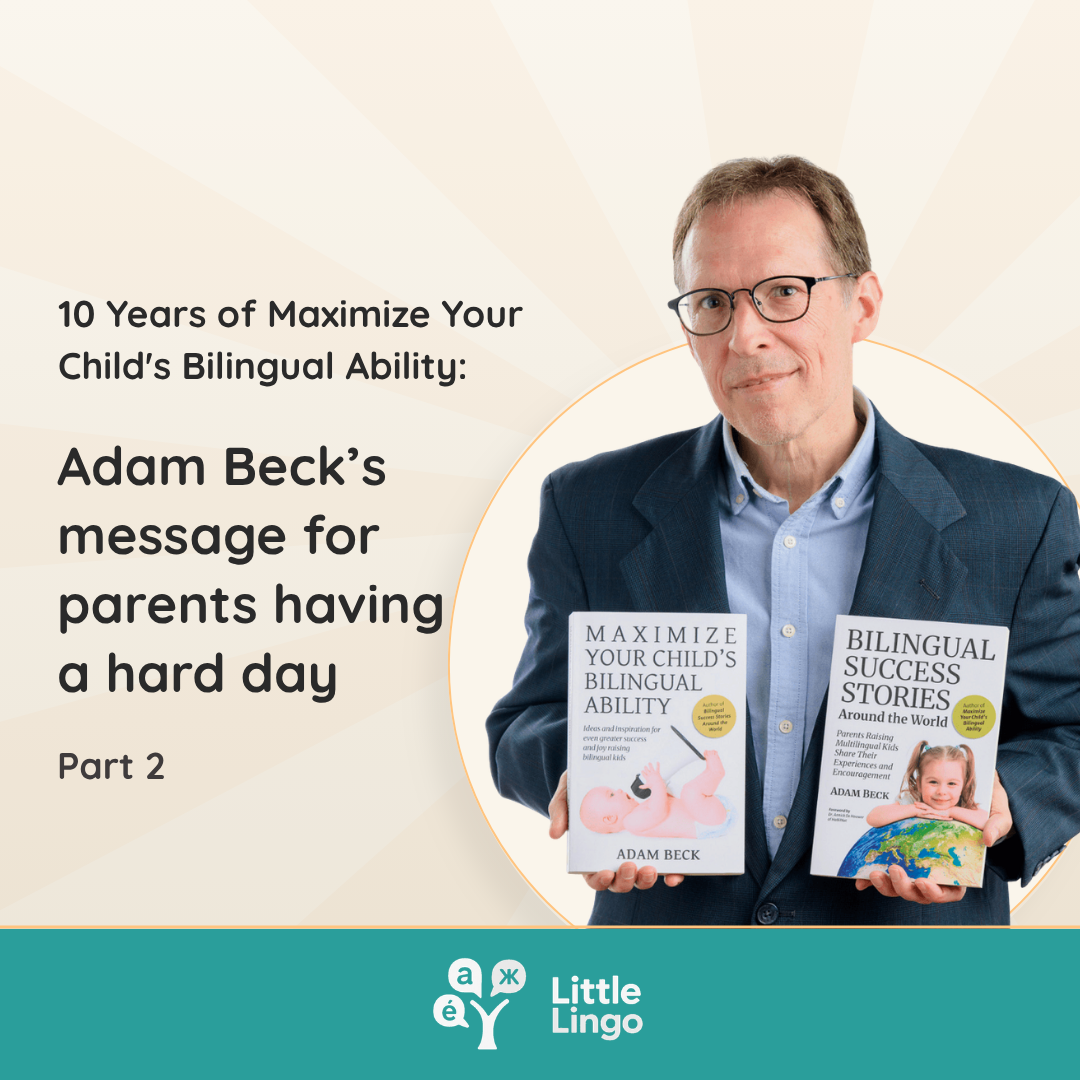
Please read part 1 of the interview with Adam Beck, author of Maximize your Child’s Bilingual Ability.
When the Odds Are Against You
6. Many of our readers are the only fluent speaker of their heritage language in the household and their partner doesn’t speak it. What’s your take on how realistic it is to raise a bilingual child in that situation?
I empathize with parents in these circumstances. My own situation was similar. My wife spoke Japanese and I spoke English, but at least my wife had enough basic English ability so I didn’t have to switch to Japanese in front of my kids. That was helpful, but the fact is the basic conditions of my situation (I wasn’t the main caregiver, my wife didn’t use English, my kids only went to Japanese schools, we rarely travelled outside Japan) were still working against my bilingual aim.

Buy your copy of Maximize Your Child’s Bilingual Ability. You can also read full review on the book.
I earn a commission if you purchase through these links, at no extra cost to you.
Think of it this way: raising a child to be bilingual is about odds, and each family’s odds of success will naturally be higher or lower depending on their particular circumstances and how proactive they are about shaping these conditions in effective ways.
If your circumstances are generally favorable, that puts the odds of success in your favor, from the start. But if your circumstances are generally unfavorable, that means the odds of success are inherently lower and those circumstances are working against you.
If that’s the case, if the odds are against you, you have to raise those odds more firmly in your favor by being proactive. Try reshaping the basic conditions themselves, to the extent you can (like in my case, I was able to start working from home), while remaining as energetic and resourceful as possible.
The absolute fact is, whatever your circumstances are, you can still experience a lot of rewarding progress on your bilingual journey. Above all, like the many other parents I’ve known who have faced such circumstances, you just have to be willing to persist in your efforts from day to day and persevere over the full length of the childhood years.
The only way to really “fail” at raising a bilingual child is to give up entirely. As long as you keep going, you keep trying, you will generate ongoing progress over time. What the final outcome will look like, we can’t exactly predict, but if you keep moving forward, doing the best you realistically can, I guarantee that your small daily steps will ultimately enable you to travel a long way with your child over the 18 years of childhood.
“Whatever your circumstances are, you can still experience a lot of rewarding progress on your bilingual journey”
The Dangerous Misconception
7. What is the most common myth about bilingual children that you think needs to be retired for good?
Among parents with a bilingual dream there’s a dangerous misconception that strong ability in both languages, including reading and writing, will happen naturally, without much effort. I say “dangerous” because, as I mentioned before, this leads many parents to badly underestimate how mindful and proactive they actually need to be in order to generate the success they’re seeking. By the time the child is three or four, the majority language is already overly dominant and the parent is feeling shocked and discouraged. It certainly isn’t “too late” to turn things around, and get on a more productive track for the minority language—I’ve helped many parents do this so I know it can be done—but, at that point, the bilingual aim is now even harder. Many parents even end up abandoning their bilingual dream out of frustration and disappointment.
If you truly want to experience bilingual success—and especially, to maximize your child’s bilingual ability, including their literacy skills—it’s far better to be mindful and proactive about your efforts right from the start, so the minority language can grow well alongside the majority language. If your child attends a majority language school, that language will eventually become more dominant, that’s only natural, but it’s okay as long as the minority language remains strong and active, too.
Thus, you’ll have a much greater chance of realizing this satisfying outcome if you’re intentional about how you navigate the whole process of your child’s language development, making conscious choices and pursuing strategic actions that will empower this organic process and enable it to unfold as effectively as possible.
“By the time the child is three or four, the majority language is already overly dominant and the parent is feeling shocked and discouraged.”
6,570 Days
8. What’s a small, everyday moment (something most parents wouldn’t think twice about) that you’d say is a meaningful bilingual win?
Remember this: Every moment is meaningful because every moment counts. When your bilingual journey is over, your child’s language ability will be the sum total of all the small, individual moments of language exposure and engagement that they received, day after day, over the years of childhood.
Each word spoken, each book read, each song heard—all the many, many moments like these will accumulate to produce the greater mass of your bilingual success.

It’s kind of like a stalactite. You know, those big icicle-like rock formations that hang from the ceiling in caves? They develop from droplets of mineral-rich water. Drop by drop by drop, a stalactite grows—very, very slowly. It can take hundreds, even thousands of years for a stalactite to grow just 1 inch (2.5 centimeters). Imagine how long it takes for a full stalactite to form!
But the thing is, you don’t have thousands of years to raise a bilingual child! You basically get just 18 — that’s 6,570 days. And each moment of each day can potentially be another drop of mineral-rich water which adds to the greater growth of your child’s bilingual ability.
Of course, fewer drops here and there, that will hardly matter. But, overall, you need those continuous drips from day to day. In other words, the secret to bilingual success lies in small, consistent actions which then naturally lead to substantial progress with each passing year. So make the most of each day, and especially during the younger years when you can potentially spend more time with your children and exert more influence. In the end, the larger outcome of your bilingual journey, when those 6,570 days are complete, will depend on what you do today, and every day.
“Every moment is meaningful because every moment counts”
Fail upward
9. If you could send one short message to a parent who’s having a hard day and feels like they’re failing at this, what would you say?
You don’t need to do this perfectly to experience a lot of rewarding success. Throughout human history, there has never been a perfect parent, and yet many, many parents have successfully raised bilingual children. In other words, for all parents failing is simply part of the process, to one degree or another.
The key difference, however, between parents who ultimately succeed at their bilingual aim, and parents who don’t, can be boiled down to this:
Parents who succeed fail upward. Parents who don’t succeed fail downward. Failing upward means that you keep trying, you keep learning from your experiences, and you keep fortifying your efforts over time. Your persistence from day to day, and your perseverance from year to year, enable your child’s language ability to continue growing. Despite the difficulties, you go on.
But failing downward means that your difficulties lead to discouragement and undermine your actions. The lack of daily persistence can sap your perseverance for the journey itself. And without perseverance, the whole bilingual dream might even be abandoned.
So you can’t avoid failing along the way. The question is: Will you fail upward or will you fail downward? As long as you keep going, and you try again tomorrow, that proactive momentum will carry you forward, and toward the success you’re seeking.
Three Ways to Use AI
10. If you were writing this book for the first time today, in 2026, is there a chapter or idea you’d want to add that didn’t exist ten years ago?
Yes, I’d want to include a chapter with ideas on how parents can make smart use of AI tools to help empower their efforts. It’s true, modern technology and AI are having a number of negative impacts on our lives, but it’s also true that parents raising bilingual kids can leverage these tools in strategic ways to greatly benefit their bilingual aim.
For instance, here are three ideas that bilingual parents could pursue, using AI chatbots, to strengthen their actions and stoke their children’s progress.
Use an AI chatbot to research the resources you need. Make this your first step when you’re looking for suitable books or groups or any other resource you might want. Your prompts can produce a lot of valuable discoveries to help move you forward.
2. When you have a specific question, or you face a particular challenge, consult with an AI chatbot. Ask for advice and brainstorm ideas. Exchanges like this can bring you closer to solutions.
If you need content in your target language, an AI chatbot could create it for you. Having an AI chatbot generate text—for reading aloud or for independent reading—is such a powerful idea because you can tailor that text to match your child’s age, language level, and interests. For example, if your son likes turtles, prompt the chatbot to generate a simple nonfiction article or fictional story about turtles that suits his age and language ability. Try making your child the hero of the story—like an adventure starring your son and a magical turtle. Some of my most effective and engaging literacy activities with my kids involved writing stories for them where they were the main characters. And now AI makes this even easier!
A Cast of Cute Kids
11. Ten years is a significant milestone. What does the next chapter look like for Bilingual Monkeys or perhaps for another book?
I began the Bilingual Monkeys blog in 2012. The Bilingual Zoo forum was a spin-off of the blog so parents could interact with one another. It was a lively community with thousands of members from 2014 to 2024. During this time I also published several books about raising bilingual children, including Maximize Your Child’s Bilingual Ability and Bilingual Success Stories Around the World.
I started the Bilingual SuperKids coaching program in 2024 and I’ve had the chance to work closely with over 100 parents from all over the world. My coaching work, where I help families experience greater success and joy on their bilingual journey, is deeply gratifying.
In 2025, after both my kids were in college, I thought I might write one more book that could cover the whole 30-year span of my experiences in this field, and I even managed to produce a first draft, but then I decided to move in a different direction.
The truth is, people aren’t reading books as much as they once did (that’s true of me as well!). So I started to wonder if there was another way—perhaps a more effective way for today’s world—to offer this content.
While I share the world’s mixed feelings about the emergence of AI tools, I also believe these tools can be used in innovative ways to empower our efforts, as in the ideas I described involving the use of AI chatbots.
And so I decided to pursue a new project where, instead of continuing to be the direct voice of my content—through books, blog posts, and videos “starring” myself—I would create a cast of cute kids who could be the fresh faces for my voice. In other words, I can now stand in the background and let these characters speak for me in short videos I post to social media.
In a way, this project brings me back to my younger days as a playwright and director in children’s theatre, where the children on stage served as the actors for my scripts. In this case, though, AI enables me to create my actors, too.
I realize this medium might not be everyone’s cup of internet tea, but I encourage you to give my AI videos a chance. There’s still a real person (me) behind them! I launched the Bilingual Baby Podcast in July and I’m now posting a new video each day. Check out @bilingualbabypodcast at Instagram, TikTok, or YouTube.
Meanwhile, this year I also brought together my teaching and coaching offers in one simple website, BeckBilingual. So if you’re interested in working with me personally, that’s where to start.
Buy your copy of Maximize Your Child’s Bilingual Ability: Ideas and inspiration for even greater success and joy raising bilingual kids (Paperback)
I earn a commission if you purchase through these links, at no extra cost to you.