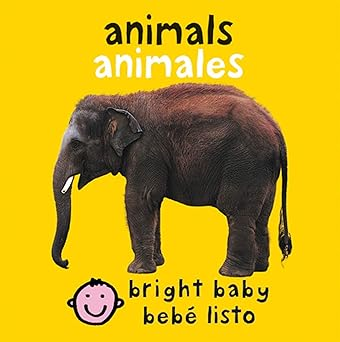

Animals / Animales Bilingual
Bilingual Bright Baby: Animals / Animales is a sturdy first-words board book that introduces animal vocabulary in English and Spanish. It’s simple, visual, and blissfully short (which, let’s be honest, is the gold standard for baby).
I earn a commission if you purchase through these links, at no extra cost to you.
About
Your baby’s first bilingual vocabulary builder with one animal per page labelled clearly in both languages. 26 pages = 26 new animals to meet = 52 new words


Why This Book is Perfect for Bilingual Babies
- It has real pictures of animals. Each page shows a real photograph of an animal with its name in English and Spanish (e.g., dog / perro). Illustrations can vary wildly (blue cows, smiling pigs, cats dressed in clothes). That flexibility is fun later, but for early bilingual learners, too much variation can muddy the mapping between word and object.
- It’s clear and simple. Clean layout. One image, two names per page. No distractions. Instead of wrestling through a 12-page narrative meltdown, you get five focused minutes of pointing, naming, giggling, done.
- It’s easy to remember for a baby. Narratives are wonderful, but they require working memory. For babies and young toddlers, especially bilingual ones processing two codes, simpler formats often stick faster.
“Great for raising a bilingual baby , all photos rather than drawings or cartoons, so you can teach what they really look like! only Hard pages too so they can’t be torn.”
Lucia
3 Ways to Use This Book
1. Point-Pause-Repeat
Sit with your child and resist the urge to rush. Point to the animal and say the word in English first. Pause for a second — give their brain space, then say it in Spanish. “That’s a dog… perro.”
“Look, a horse… caballo.” That tiny pause matters. It prevents language overload and gives their brain time to attach both labels to the same image. Calm, confident, simple.
2. One Parent, One Language (Light Version)
If both parents are involved, you can naturally split the modelling. One names the animal in English, the other adds Spanish. “Pig!”,“Sí, cerdo.” No correcting. No over-explaining. Just exposure. This keeps both languages alive in a relaxed way, especially helpful if one parent feels less confident in the second language.
3. Take the Words Into Real Life
The magic happens outside the book. When you see an animal on a walk, at a farm, in another story, on pyjamas, or even on food packaging, use the words again. “Look, a cow! Vaca!”
“That’s a cat — gato.” Repetition across contexts strengthens memory. The book introduces the vocabulary. Real life locks it in.
My Recommendation
★★★★★
Worth buying. Worth buying, especially for ages 0–2. This book is perfect if you’re right at the beginning of your bilingual journey, when you’re thinking, “Right, let’s just start somewhere.” It works beautifully for parents introducing any language in a gentle, low-pressure way, especially with babies and young toddlers whose attention spans last roughly the length of a biscuit. The simplicity is the strength.
The book is a calm, clear first step into bilingual life.
Tip: Start with animals because they’re emotionally sticky. Children connect to them instantly.
Language Simplicity
Simple animal names in English and Spanish
Visual Support
Strong support: image – name
Sensory Engagement
Sensory is limited to photos of animals on bright backgrounds
What Works
+ The book is simple, it works in any language
+ Works perfectly if Spanish isn’t your first language
+ Thick board pages survive chewing
+ Real photography (not images)
+ Affordable entry point into bilingual books
My Concerns
– No storyline
– No sentence modelling
– May feel too simple for older toddlers
– Limited vocabulary
– Repetition fatigue if overused
Build the Collection


No Title
Perfect for a baby
Maria Ivanova, Multilingual parent & book reviewer
Jan, 2026